
Telecom operator Bharti Airtel on Tuesday reported a 91.5 per cent year-on-year rise in consolidated net profit at Rs 1,588 crore for the three months ended December 2022, helped by competitive growth across businesses. Total revenue rose nearly 20 per cent to Rs 35,804 crore in the third quarter of the current financial year "backed by strong and consistent performance delivery across the portfolio", the company said in a statement. Its consolidated net income (after exceptional items) stood at Rs 1,588 crore for the just ended quarter, translating into an increase of 91.5 per cent year-on-year.

SBI Cards and Payment Services reported numbers that met Street expectations in the first quarter of the 2023-24 financial year (Q1FY24). The net profit came in at Rs 590 crore, while pre-provision operating profit grew 17 per cent year-on-year (YoY) (a little better than expectations). But provisions were hiked due to surprise stress from pre-Covid-19 period of 2018-19, and that dragged earnings.

Premier League clubs spend $1 billion for first time in January transfer window

Here are the key numbers to watch out for in the Budget for 2022-23, which is widely expected to boost spending towards policies that create jobs, boost manufacturing, helping rural and agri-economy and infrastructure creation. Sitharaman, who had in her first budget in 2019 replaced leather briefcase -- which had been in use for decades for carrying budget documents -- with a traditional red cloth 'bahi-khata', has spurt in tax collections to her aid in the budget that is expected to a spend-all budget.

Coming Wednesday, Finance Minister (FM) Nirmala Sitharaman will present the 2023 Union Budget - the last full Budget ahead of the 2024 Lok Sabha elections. While India exited 2022 as a relatively bright spot in the global economy, the FM will endeavour to present a Budget that insulates India's economy against global headwinds and recession in advanced economies, while sticking to the path of fiscal consolidation. In this, she is being helped by her core team of trusted advisors.

The Union government could target a fiscal deficit of 5.8-6 per cent of nominal GDP for 2023-24, and it should continue its capital expenditure push and look to simplify the personal income tax regime, economists recommended Finance Minister Nirmala Sitharaman and her team during their pre-Budget interaction on Monday. Starting last week, Sitharaman had eight pre-Budget consultations this time. More than 110 invitees representing seven stakeholder groups participated in these meetings, the finance ministry said in a statement. The stakeholder groups included representatives and experts from agriculture and agro-processing industry; industry, infrastructure & climate change; financial sector and capital markets; services and trade; social sector; trade unions and labour organisations; and economists.

The finance ministry will kick-start the exercise to prepare the Union Budget for financial year 2022-23 (FY23) from October 12, according to an official notification released on Monday. "The pre-Budget meetings as well as the meetings to discuss the revised estimates will start from October 12 and will continue till the second week of November," according to the Budget circular of the Department of Economic Affairs' Budget Division. The Union Budget is expected to be announced on February 1, as has been the practice of the past few years.

There is no near-term respite for the country's largest fast-moving consumer goods maker, Hindustan Unilever (HUL), which is facing multiple challenges on the growth front. With demand showing no signs of improvement, especially in the rural segment, the October-December quarter (Q3) of 2023-24 (FY24) is likely to be similar to the previous quarter, with volume growth in the low single digits. The stock, which is down 7 per cent over the past year compared to the 11 per cent jump for the S&P BSE Sensex, could underperform the benchmark in the near term as well.

The Union government's fiscal deficit works out to be Rs 5.47 lakh crore or 36.3 per cent of the budget estimates at the end of October 2021 on the back of improvement in revenue collection, according to the data released by the Controller General of Accounts (CGA) on Tuesday. The deficit figures in the current fiscal appear better than the previous financial year when the gap between expenditure and revenue had soared to 119.7 per cent of the last year's Budget Estimates (BE) mainly on account of a jump in expenditure to deal with the COVID-19 pandemic. In absolute terms, the fiscal deficit was Rs 5,47,026 crore at the end of October, the CGA said.

Clawing the economy back to an 8 per cent growth path will require bringing savings and investment rates closer to 35 per cent on a sustained basis, which were 30.2 and 29.6 per cent, respectively, in FY22, according to a report. As per India Ratings, a large part of investments will have to be in infrastructure, which can help revive private investments by easing supply constraints and offset the weakening of external demand due to global headwinds. Higher investments will have to be accompanied by higher domestic savings to keep the savings-investments gap under check.

'A key reason for the strong interest in IPOs has been an increased focus on profitability and reasonable pricing of deals.'

For fiscal year FY23, the 2022 Union Budget had targeted a capex outlay of Rs 7.5 trillion, which is 35.4 per cent higher than the FY22 Budget Estimate of Rs 5.54 trillion.

While the likelihood of these states going the Lanka or Greece way may be an alarming assessment, the financial situation of some states such as Punjab and West Bengal is indeed quite weak.

The government plans to borrow a record Rs 15.4 lakh crore from dated securities in FY24 to meet its expenditure requirement to prop up the economy.

Chairing a meeting to review the security situation in LWE-affected states, Shah said the Modi government has adopted a policy of zero tolerance against left wing extremism since 2014.

India's number one tennis player Sumit Nagal is left with less than Rs one lakh in his bank account and a morose feeling of not leading a good life.

India recorded economic growth of 7.8 per cent in the April-June quarter of 2023-24 against 13.1 per cent in the year-ago period, as per the National Statistical Office (NSO) data released on Thursday. India remains the fastest-growing major economy as China's GDP growth in the April-June quarter was 6.3 per cent.

Wall Street-correlated stock markets are facing the risk of correction, as Christopher Wood, the global head of equity strategy at Jefferies, conveys to investors in his latest edition of GREED & fear. Rising crude oil prices, which are nearing $100 a barrel (Brent), pose a threat to the global central bank's battle against inflation and have led to a re-evaluation of its exposure to Indian stocks. "The potential for more US Federal Reserve (Fed) rate hikes, combined with the risk that monetary tightening finally bites as regards the economy, remains a risk for Wall Street-correlated world stock markets. "There is also the oil factor. This is why GREED & fear continues to believe the pain trade is down. "Areas in Asia, such as Indian midcaps, which have already done very well, are at obvious risk of some profit-taking," writes Wood.

Reliance Industries (RIL) was the top-performing index stock on Friday (May 26) and closed the day with gains of 2.8 per cent, against a 1 per cent rise in the benchmark S&P BSE Sensex during the day. RIL's performance on the bourses on Friday was, however, an exception, and the stock has struggled to beat the broader market for nearly two years now. The company's share price is currently at the same level as in September 2021, while the benchmark index is up 6 per cent in the period.

After the government sought Parliament's nod for a second batch of supplementary demand for grants that will cause a hit of Rs 2.99 trillion to the exchequer, doubts suddenly arose about the government's ability to meet the Budget projections of reining in its fiscal deficit at 6.8 per cent of gross domestic product (GDP), or Rs 15.06 trillion, for the current financial year. Till now, many were of the opinion that the government would succeed in checking the deficit at a much lower figure than what was given in the Budget Estimates (BE). The government had sought Parliament's approval to spend Rs 3.74 trillion extra, but Rs 74,517.01 crore will be matched by equal savings on other heads.

The negative balance is largely on account of pending material cost for the work done under the programme during the year and even earlier.

The government is close to approving a proposal by Micron Technology to set up an assembly, testing, marking and packaging (ATMP) facility in the country involving an investment of about $1 billion. The world's fifth largest semiconductor company, based in Idaho, USA, will use the facility to process some of its own wafers, manufactured across the globe.

After bumbling for years since 2014, the Modi government seems to believe that massive government expenditure will lead us to prosperity supported by 'seat-of-the-pants' decision-making, observes Debashis Basu.

Finance Minister Nirmala Sitharaman on Tuesday said the country's economic growth is expected at 9.2 per cent in the current financial year, on the back of a sharp rebound in the economy. She also said virtuous cycle of investment is expected to revive on account of capex (capital expenditure) and crowd in private investment. "Government focus since 2014 is on poor and marginalised.

If the Centre and states are keen on spending more to meet the COVID-19 challenges in the coming year, they must bear in mind the need to raise more resources through taxes and non-tax revenues, suggests A K Bhattacharya.

The Reserve Bank of India on Thursday kept the benchmark interest rate unchanged at 4 per cent and decided to continue with its accommodative stance against the backdrop of an elevated level of inflation.

Being driven to abandon Indian middle-class values, asks Ajit Balakrishnan.
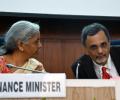
'... and without necessarily calling them Economic Surveys.' 'One should stick to the main focus, which is to give people a good perspective on how the economy is doing.'

26 tigers have already died this year.

The Sports Ministry has got a fillip with the government allocating Rs 3,397.32 crore, an increase of Rs 723.97 crore, in the Union Budget on Wednesday.

A strong business update for the April-June quarter of the 2023-24 financial year Q1FY24 has led to a big jump of over 7 per cent in the share price of Bajaj Finance on Tuesday (July 4). The non-banking financial company's (NBFC's) new loan book grew 34 per cent with 9.9 million new loans booked in Q1FY24 from 7.2 million loans booked in Q1FY23. The company's total customer franchise rose to 72.98 million (as on June 30, 2023), compared to 60.30 million year-on-year (YoY) with the highest-ever quarterly increase of 3.84 million in Q1FY24. Assets under management (AUM) grew by 32 per cent to about Rs. 270,050 crore in Q1FY24 from Rs. 204,018 crore in Q1FY23.

HDFC Bank Q1FY24 results analysis: Shares of HDFC Bank, the world's seventh largest financial entity, have advanced 2 per cent in two days, as against 1 per cent rise in the benchmark S&P BSE Sensex, after the lender reported its April-June quarter (Q1) results for financial year 2023-24 (FY24) on July 17. The S&P BSE Bankex index, meanwhile, has gained 1.3 per cent. While the near-term stock performance may remain sideways due to merger-related hiccups, analysts remain bullish on the stock's long-term prospects.

'Although mid- and small-cap funds have the potential for higher growth, they come with inherent higher volatility.'

'Indian equity valuations, although not very expensive, are not cheap either.'

Punjab has over 400,000 employees and pensioners and about 125,000 staff members in its corporations and boards.

Except for Westlife Foodworld (Westlife), a weak 2022-23 (FY23) January-March (fourth quarter, or Q4) quarter performance and a muted near-term outlook led to a downward revision of earnings estimates for quick-service restaurant (QSR) players. Brokerages have slashed estimates by as much as 10 per cent for 2023-24 (FY24) and 2024-25 (FY25). The downward revisions have weighed on the performance of listed players, who have underperformed the market with low single-digit returns over the past month.

The share of foreign companies in private sector investments, directed towards building new factories and other facilities, has declined over the past six months. A mix of large domestic announcements and relatively lower growth in foreign capital expenditure (capex) plans have played a role, although foreign investments remain near record levels. The share of foreign companies in the overall private sector investments over the four quarters ended June 2023 has dipped to 14.9 per cent, as shown by a Business Standard analysis of data from the project tracker Centre for Monitoring Indian Economy.

Seven consecutive sessions of decline in the equity market has eroded the wealth of investors by a whopping Rs 10.42 lakh crore and the benchmark Sensex has tumbled more than 2,000 points during this period. Concerns over more rate hikes by developed economies, weak global equity markets and fresh foreign fund outflows from the domestic market have dented investor sentiments. On Monday, the BSE Sensex dropped 175.58 points or 0.30 per cent to end at 59,288.35 points, marking a decline for seven straight trading sessions.

Sources in the Delhi government said the ministry of home affairs has stopped the Kejriwal government's budget and it will not be tabled in the assembly on Tuesday.

Since infrastructure projects have long gestation periods, investors need to enter them with a long horizon of at least 10 years.
